
Nintendo’s newest console has been on shelves for just over a year, and its security wall now has a crack in it. A researcher has used a programming environment built for the original Switch to pry open the Switch 2, running homebrew software on hardware Nintendo intended to keep sealed.
The entry point is SmileBasic 4, the latest in a long running series of programming environments and interpreters that have appeared on Nintendo hardware over the years. The technique falls into the category the hacking community calls a tethered hack, and it carries an extra requirement: a macOS or Linux PC on the same network, running a node.js package that helps unlock privileged system access.
In his write up, researcher Sammy Hajhamid explains that he turned OpenAI’s Codex loose on the SmileBasic language interpreter. He assembled a custom harness capable of sending USB commands to the console and reading the results back over HDMI, with a Bluetooth device built to flip a light switch handling the power cycling. After what he calls “substantial effort for ~2 weeks,” the rig surfaced a 32-bit integer overflow that occurs when items are deleted from an array in SmileBasic.
That flaw yields an array pointer, and through it the ability to read from and write to portions of system memory. From there, Hajhamid began probing the Switch 2’s internal sysmodules in search of one that would grant deeper access to the console’s core functions. He eventually landed on a buffer overflow in the FileSystem services module, which exposed a cached data pointer and handed over arbitrary read and write privileges.
With that foothold in hand, Hajhamid writes that he was able to perform “privileged filesystem actions” and, in time, reach native code execution by way of a faked filesystem process.
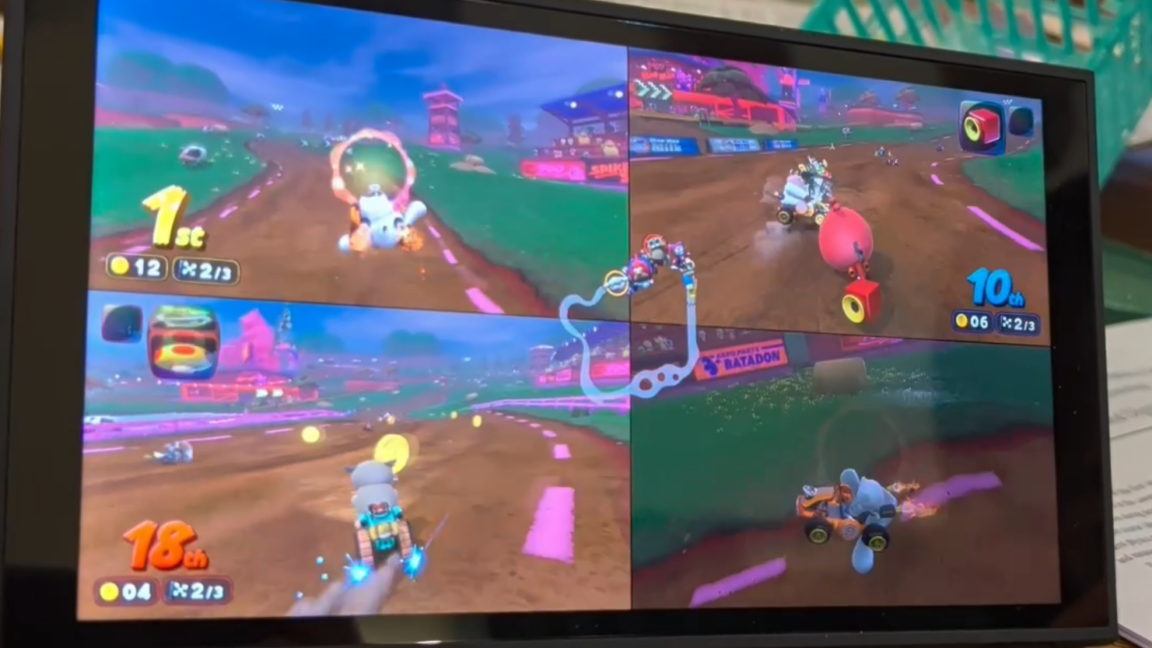
Hajhamid, who goes by Pepsipu online, put the exploit on display by loading a batch of modded characters into Mario Kart World. Others in the Switch 2 hacking scene have posted their own basic demos and unfinished developer tools running on compromised hardware, among them a demonstration titled “Full Vulkan GPU working in userland” shared by u/Icy-ConcentrationC on the switch2hacks forum.
A tight sandbox rather than full control
The exploit, however, remains a userland one. Homebrew developers working through it stay inside a relatively small sandbox and sit well short of the kernel level access that would deliver complete command of the hardware.
The SmileBasic name will be familiar to anyone who followed Nintendo handheld hacking a decade ago. The 3DS edition of the same software proved central to smilehax, an exploit that became public in 2016. Nintendo withdrew SmileBasic from the 3DS eShop shortly afterward, and SmileBasic 4 has already been delisted from the Switch eShop worldwide. A Japanese demo version that may behave in a similar fashion was still reachable when this story was published.
That delisting could help slow the exploit’s spread to the broader base of Switch 2 owners who never bought or downloaded SmileBasic. It will not close the door entirely. Other hackers are already teasing similar exploits that appear to work through different games.
The current method functions on the newest Switch 2 firmware, version 23.0.1. Even so, this particular vulnerability seems likely to be patched out in firmware releases due imminently, updates that owners will need to keep access to many Nintendo services and to play future game releases.
Set against the console’s history, the news is unwelcome for Nintendo but nowhere near its worst scenario. The original Switch was compromised by a 2018 exploit that earned the label “unpatchable” and forced a complete hardware redesign to keep later systems safe.
What stands out is the speed. Hackers have gotten this far only a little more than a year after the Switch 2 launched, which is not a good sign for the overall impregnability of Nintendo’s system software. The familiar cycle, with hackers probing and platform holders patching, is already turning again.
For now the crack is narrow, tethered to extra hardware and likely to be sealed by a firmware update, but it shows that the Switch 2’s defenses are not impenetrable. Nintendo’s engineers and the hacking community appear set for another long contest over the console’s deepest recesses.



