
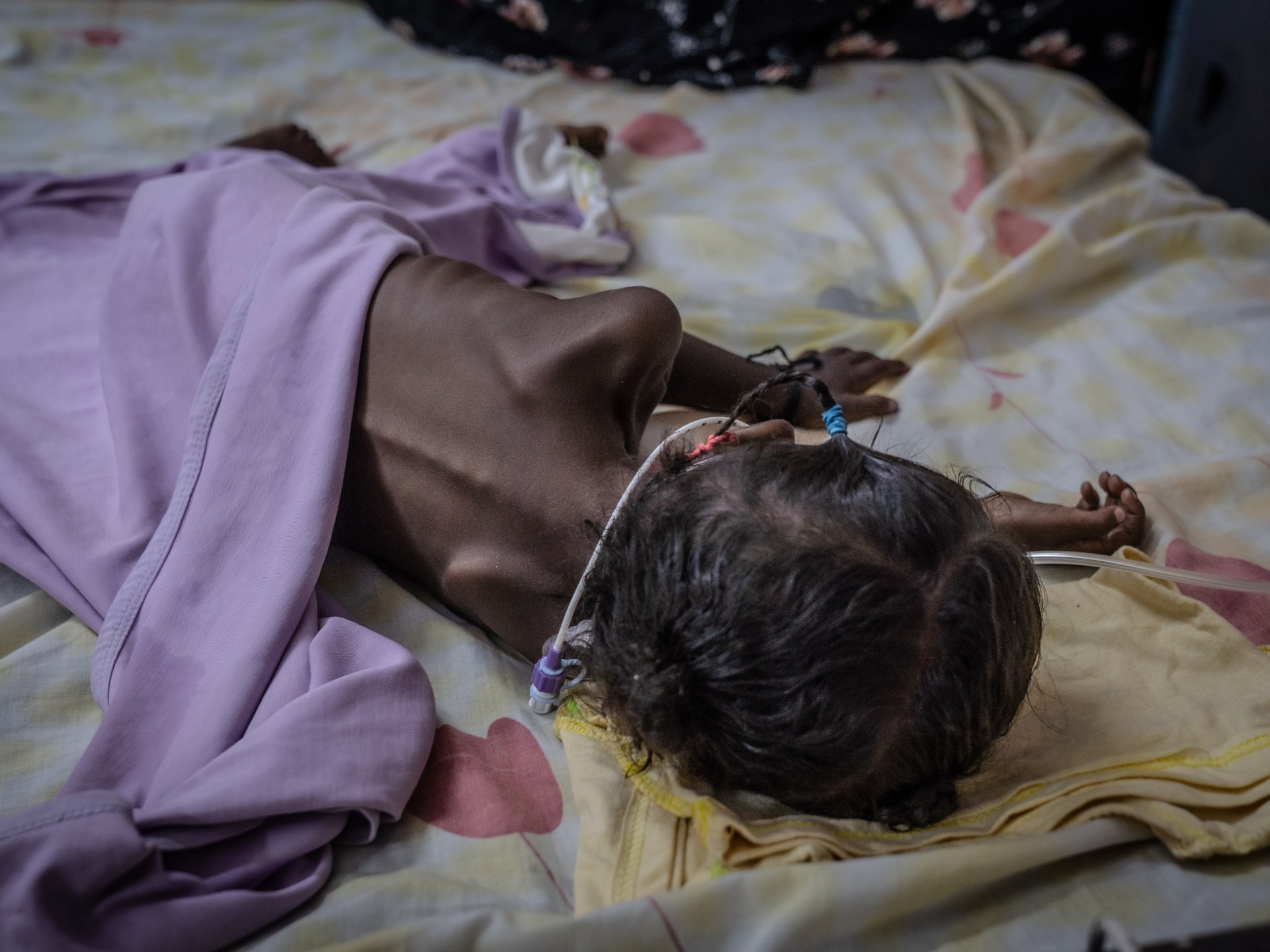
Layla Ali made a two and a half hour journey from al-Lalouba to Port Sudan after her five year old son, Adam, became so severely malnourished that his ribs showed through his skin. The boy had lost his appetite two weeks earlier and was too weak to move. Worry about the distance and the cost of care had kept his mother from setting out sooner; when his condition worsened, she rushed him to hospital.
Adam spent five days in hospital while he received treatment, according to his mother. His malnutrition has recurred, and this time Ali said she brought him in because she feared he could die.
“We spent five days in hospital while my son received treatment. He suffers from recurring bouts of malnutrition, but this time we brought him to hospital because I was afraid he might die,” Ali told Al Jazeera.
She said Adam would stop eating when he became ill and that she used to give him the family’s usual meals, mostly porridge and milk. “But the doctors have now helped me understand which foods are appropriate for his age and the nutrients he needs,” she said.
Adam’s case reflects a wider crisis facing children across Sudan, where a civil war has continued since April 2023 between the Sudanese Armed Forces (SAF) and the Rapid Support Forces (RSF) paramilitary.
The Integrated Food Security Phase Classification (IPC) estimates that 825,000 children under five will suffer from severe acute malnutrition in 2026, a 7 percent increase from 2025. In the first six months of this year, UNICEF and its partners treated 174,700 children with severe acute malnutrition nationwide. The Port Sudan Teaching Hospital has recorded 433 cases between January and August this year.
The impact is also visible in Omdurman, where two year old Riham Ata, admitted from a recently liberated area of Khartoum, lay on a gurney in one of Al-Buluk Hospital’s severe malnutrition wards. Al-Buluk was Khartoum’s only functioning pediatric hospital during the civil war that began in April 2023.
A hospital under strain
Maryam Gadalsid, a nutrition counsellor at the Port Sudan Teaching Hospital, said the number of children admitted with malnutrition continues to rise, forcing medical staff to accommodate as many as possible. The 17 bed malnutrition unit now holds three children to a single bed, she told Al Jazeera, increasing the risk of disease spreading among patients.
“Medical staff assess each child’s condition before providing essential supplies, including therapeutic milk and other nutritional supplies free of charge, with support from the World Health Organization (WHO) and UNICEF,” Gadalsid said. “However, intravenous fluids and medication remain a significant financial burden for many families, struggling with the economic crisis caused by the war.”
Gadalsid added that inadequate nutrition among pregnant women, driven by displacement and economic hardship, was also putting their babies at risk of poor growth and malnutrition. An increase in the numbers of flies, which can contaminate food and water, and mosquitoes, which transmit malaria, was worrying, she said. Malnourished children, in particular, are at risk of these diseases and viruses.
“With the onset of winter, malnutrition cases increase [and] … the number of flies rises, contributing to the spread of diseases that cause malnutrition,” she said.
Darfur and Blue Nile under pressure
The situation is particularly bad in western Sudan’s Darfur region, which had already faced two decades of war before the 2023 nationwide conflict broke out. Darfur has been an epicentre of the current conflict and is currently an RSF stronghold. Fighting there, combined with hunger and disease, has created an increasingly desperate situation for millions of civilians, particularly women and children.
In North Darfur alone, there were at least 40,000 cases of malnutrition between January and May 2025, according to UNICEF, when the RSF imposed a siege on the state’s capital, el-Fasher. The city was later taken by the RSF in October, and the paramilitary group is accused of killing thousands of civilians there.
In Blue Nile State in southeastern Sudan, malnutrition is also taking a growing toll on displaced children. Sabri Adam, deputy head of the committee overseeing al-Karama 3 displacement camp in the state capital al-Damazin, told Al Jazeera that cases had risen from 1,800 in September to 2,116 in November, accounting for more than a quarter of the camp’s children. Of those affected, 1,760 are under the age of five.
According to Adam, al-Karama 3 is home to more than 7,600 children under the age of 10, among almost 4,000 displaced families. They had fled areas in western Blue Nile State, including al-Tadamon, Bau and Kurmuk, where military operations between the SAF and the RSF have intensified.
“These families arrived at the camp in extremely difficult humanitarian conditions, amid limited funding and humanitarian assistance from organisations, and a lack of health monitoring despite the growing needs of displaced people,” he said to Al Jazeera.
Adam said the camp received cash assistance from the Red Crescent earlier this month to support people affected by malnutrition and pregnant women. Each eligible household received 620,000 Sudanese pounds (about $60 at the parallel market rate).
Drought and late treatment
The IPC warns of a growing risk of famine across parts of Greater Darfur and Greater Kordofan. Conflict, mass displacement, severe drought and inadequate humanitarian funding are driving a further deterioration in food security.
The El Nino climate phenomenon has led to reduced rainfall in Sudan during the rainy season, leading to drought that is affecting roughly half of the country. According to the IPC, nearly two thirds of farmland in North Darfur and roughly half in South Darfur and Kordofan states have had poor vegetation growth, threatening harvests and leaving families facing higher prices and worsening hunger.
At the Port Sudan Teaching Hospital, Dr Ahmed Youssef, the medical director of the paediatric department, said increasing malnutrition was driven not only by the effects of war and displacement but also by limited nutrition awareness or accessibility among families, particularly in rural communities. Many families in smaller villages across Sudan rely heavily on flour and milk as staple foods, with meat largely absent from their daily diets.
“We are working to provide families of children with malnutrition with basic nutrition education as a first step towards tackling the problem. However, we face difficulties reaching villages to deliver healthcare and raise awareness,” he told Al Jazeera.
Food contamination is another obstacle. Unreliable electricity supplies and a lack of refrigerators in many households make it hard for families to store food safely, Youssef said.
“Families often bring their children to hospital only when malnutrition has reached an advanced stage, either because of financial hardship and fears about treatment costs or because of limited education,” he said.
Adam spent five days in hospital, his mother said, and Ali now has clearer guidance on the foods he needs. Their journey mirrors the pressures described by health workers and camp representatives across Sudan, where war, displacement, drought and funding shortages continue to leave families struggling to feed their children.



