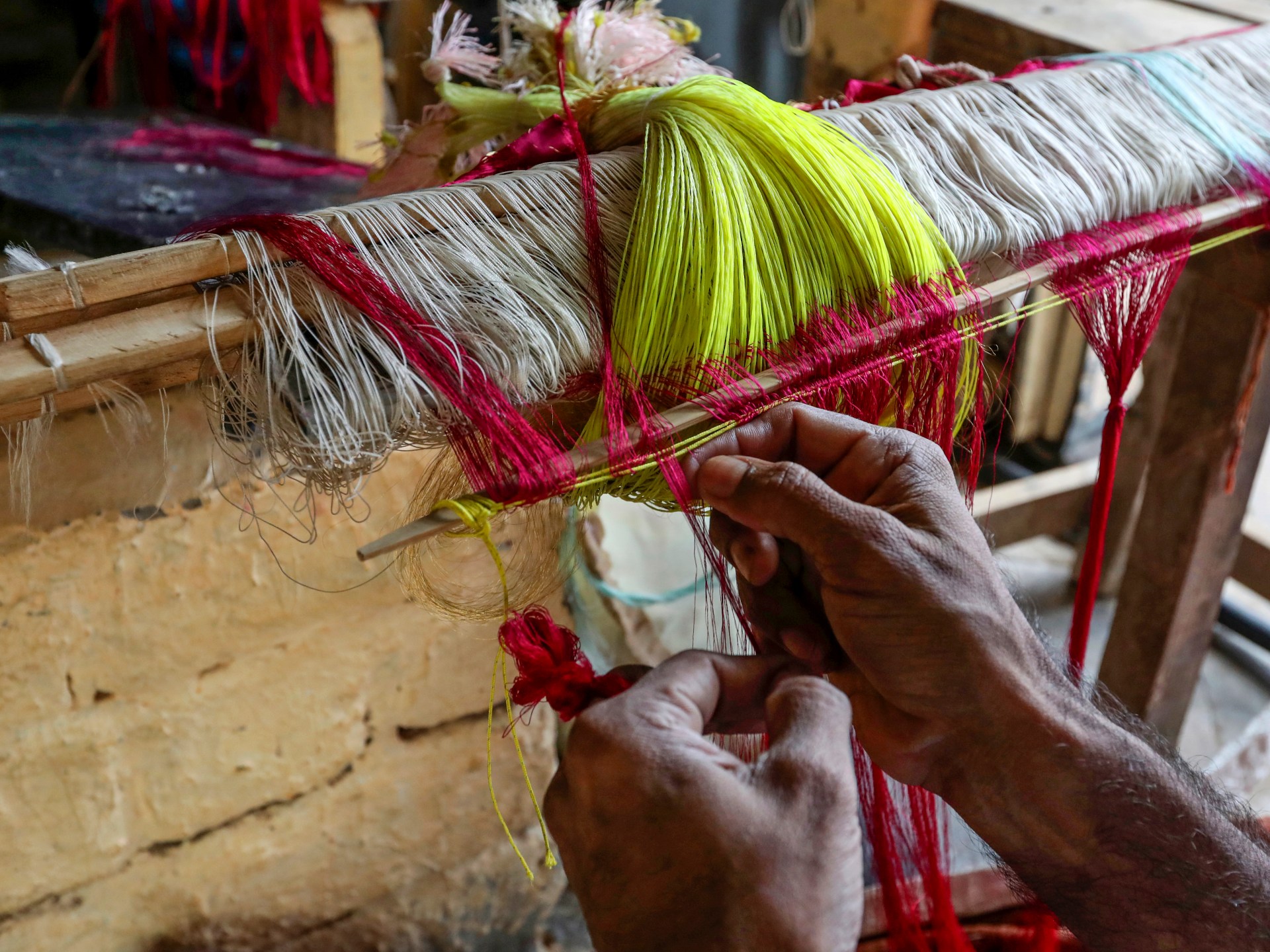
Bitupan Deka was out buying a gamusa, the traditional scarf worn across India’s northeast, with his mother in Meghalaya when a detail about the shops stopped him. Every stall selling the scarf, he recalled, carried the same small cluster of patterns, repeated again and again.
When he asked around, the reason became clear. Weavers in Sualkuchi, a district in neighbouring Assam, are paid a flat sum of roughly 2,000 rupees ($21) for each design they create instead of earning royalties, and manufacturers had worked out that keeping the number of designs low held costs down.
The answer stuck with Deka, an assistant professor of computer technology at MIT University in Shillong, the capital of Meghalaya. He began building a system that can generate an unlimited supply of fresh designs for fabrics such as the gamusa.
“My work isn’t meant to replace the traditional designers. I hope, instead, that it will become a tool in their hands to create new and modern motifs more easily, so the consumers can have variety,” Deka told Al Jazeera by telephone from Shillong.
The patent is being sought through the research and development department of his university. Once it is granted, Deka intends to turn the system into a commercial design service for the textile industry.
Patterns and motifs across India’s many textile traditions are more than ornament. They hold the memory of a place and the mythology of its people, and at times the record of migrations. Weavers imagine them from the things around them and colour them with pigments available locally, often using carved clay and wooden frames. Such a weaver does not simply reproduce a motif. The motif is inherited. The hands hesitate where a grandmother’s hands hesitated, and the maker knows why a particular flower has to face left.
A computer inherits nothing and hesitates at nothing. It learns by analysing images and repeating them in endless variation. Yet, as Deka’s system shows, it can now draw that same flower.
Archives that double as raw material
The Rekh Sanganeri Dataset works on similar lines for the hand block printed Sanganeri textiles of Rajasthan in western India. It contains high resolution images of printed patterns, annotated down to the ink bleed and slight misalignment that mark handmade work as handmade. Reddy Sai Nivas C, who developed it, says the dataset should serve research and art rather than stand in for artisans.
The caveat carries its own contradiction: a tool built to preserve a craft also makes its visual language simpler to reproduce digitally, with no craftsperson involved.
Dinesh Chhipa comes from one of the oldest Chhipa families, a caste of artisans and merchants known for dyeing and block printing. He designs in the Bagru style, a block printing method from Bagru town in Rajasthan, and is also a textile businessman.
“Traditional craft is slow to produce. Even if someone offered us a fortune, we wouldn’t be able to produce these pieces in mass numbers, so I don’t fault those using digital technology and AI to fill the gap,” he told Al Jazeera.
“But don’t borrow craft and regional names like Bagru and Jaipuri [named after the capital city of Rajasthan]. These designs and motifs were born out of a culture and necessities of the communities they come from.”
India has spent years digitising this textile memory, from historical collections held by the Botanical Survey of India to the Bharatiya Vastra Shilpa Kosh, a national portal built by the state run National Institute of Fashion Technology and the Centre for Development of Advanced Computing (C-DAC).
Without documentation, fragile traditions and the knowledge attached to them could disappear. But the same archive lies open to any AI system seeking to reproduce those crafts at scale.
At the India AI Impact Summit in New Delhi in February, the software company Tata Consultancy Services (TCS) presented Bridgital Loom, a system that converts textile designs into instructions a loom can follow. LED lights on the loom guide a weaver through the thread sequences of intricate Banarasi and Kanchipuram patterns, named for the cities where those arts grew.
TCS says the technology helps weavers complete complex designs faster and with fewer errors, and describes it as a bridge between artisans and technology. A pilot project using the loom is already under way in Kanchipuram, a town in the southern state of Tamil Nadu.
In an interview with the online platform Digit at the summit, the head of AI strategy at Bridgital Loom, Muthulakshmi Nellaiappan, noted that a new weaver needs more than 15 years to master the art. “With the technologies we have in hand … the younger weaver who has just entered the skill can become a master much sooner,” she said.
She added that since a large percentage of India’s looms are not electronic, TCS made sure its system also works on handlooms, which she said was essential for scaling the technology.
Technology flattens the hierarchy of master and apprentice on which traditional knowledge rests. The weaver no longer has to conceive or remember patterns, colours and codes, but follows the machine’s instructions, and creativity and memory pass to the AI. That raises a further question: who owns a culture once it becomes plain data?
Names that belong to places
For generations, India’s textile knowledge has sat outside intellectual property systems. It lived in community memory, handed from master to apprentice with no certificate of ownership. Kanchipuram, Mekhela-Sador, Sanganeri and Banarasi are the names of places these textiles helped shape, not merely places they emerged from. That knowledge is now entering generative models that owe those traditions nothing.
For designers and manufacturers the appeal is hard to resist: motifs combined at will, colours changed with a command, thousands of designs generated in an instant. The machine offers abundance. The artisan has always lived with scarcity, of money, of bargaining power, of recognition.
Ananthalakshmi Vadivel, a third generation weaver who owns Vadivel Silk Looms in Kanchipuram, says her venture is already competing with cheaper Kanchipuram sarees turned out on electronic looms.
“Perhaps, with AI, these sellers can create trending designs faster and cheaper to attract mass consumers. But these imitations can never replace the original,” she told Al Jazeera.
“There will always be a market for authentic Kanchipuram and handcrafted textiles, no matter how much technology makes the imitation cheaper. True Kanchipuram weave, colour, and designs can only be created by hand, and discerning buyers know this.”
Whether AI can recreate a textile is no longer in doubt. It can. What remains unresolved is who gets paid when it does.
Intellectual property law assumes a work that can be traced and an author who can be named. A motif is communal property, its technique passed down over generations with no single originator.
In the capital, the government is planning a dedicated AI and handloom research department under the Centre of Excellence for Handloom Technology at the Indian Institute of Technology (IIT). The facility, inaugurated in August at a cost of $1.4m, is meant to modernise the handloom sector by combining weaving heritage with contemporary technology.
The government also plans to register thousands of weavers, fit their handlooms with sensors that convert weave patterns into digital data, and issue QR coded tags that trace provenance. In Maharashtra, the Vingatha system does something similar at state level, authenticating handloom sarees such as Paithani and Karvat Kathi.
The reasoning is simple: if a saree can tell you where it came from, the person who made it becomes harder to erase. Such measures cannot stop design and mass production enabled by AI, but they may give artisans more visibility and turn each piece into an archive.
From craft to contemporary art
In galleries, traditional textiles are increasingly shedding the label of craft for the more lucrative category of contemporary art. Gurjeet Singh, an artist from Chandigarh, recently held a solo show built around textiles in New York, transforming discarded fabrics, buttons and embroidered scraps into sculptures that explore queer identity and the social prejudices surrounding gender and sexuality.
Sayan Chanda, an Indian artist based in London, works with cut and rewoven vintage Bengali quilts to question fixed notions of cultural belonging. Sumakshi Singh, who works from Gurugram, uses delicate embroidery and suspended thread structures to reconstruct architectural fragments of vanished homes, gardens and personal histories. There are many more.
In New Delhi last month, 20 such artisans and craft collectives featured in an art show celebrating traditional textile crafts.
“Our aim is to present these traditional crafts as living practices that continue to evolve through contemporary artisans, rather than as heritage to be archived. Kanmai Payun, one of the artists featured in the show, for example, is the last practitioner of Fulor Saneki, a flower pattern used by Assamese weavers. We encouraged her to teach her 17-year-old son so the craft outlives her,” Aparupa Ray Ganguly, the curator of the show, told Al Jazeera.
But as textiles gain value in galleries, their makers do not automatically gain control over their work. In April, another exhibition in New Delhi, titled No ‘One’ Maker, saw artisans missing from the show’s preview, exposing how traditional textiles are aestheticised while the people who carry that knowledge remain unrecognised.
For Chhipa, the artisan and merchant from Rajasthan, the answer to the ownership question begins with the names themselves. “You cannot separate the names from the community,” he said. “Call your mass-produced work digital prints and leave the traditional names to the original artisans.”