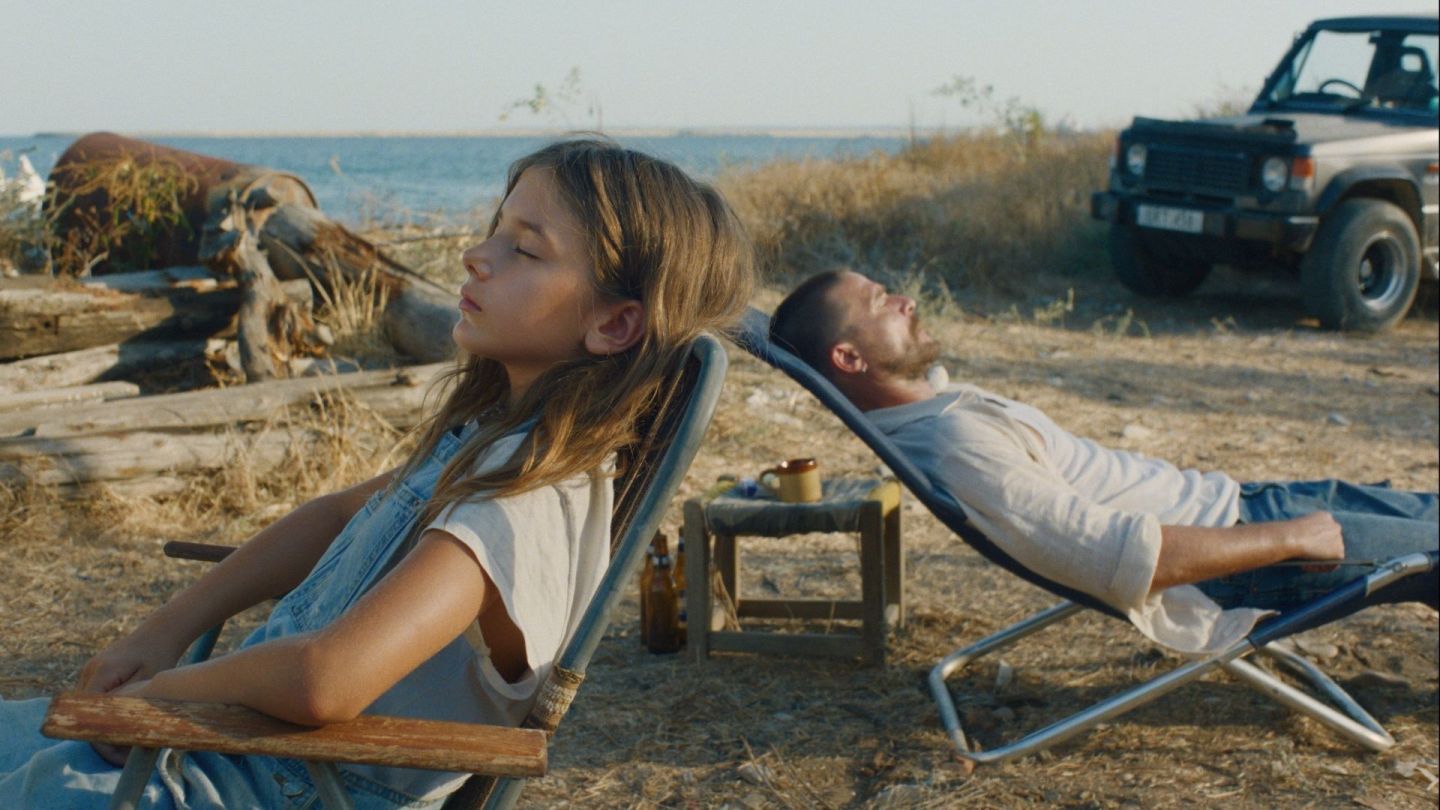
A girl of 11 meets the father she has never known at her grandfather’s funeral, and what follows is neither a tidy reunion nor a clean break. That is the premise of Hold Onto Me, the first feature from writer and director Myrsini Aristidou, and it has already carried Cyprus somewhere the island has never been before: into the international feature film race at the Academy Awards.
The film unfolds over a Cyprus summer. Iris, 11, passes her days alongside Danae, a best friend a little older than she is. Then news lands that her grandfather has died, and the funeral brings Aris to town, the father she has never met. He is a small time criminal with no appetite for responsibility. Iris refuses to let him slip away, and she ends up drawn into his schemes even as her mother and her older brother warn her off. What starts as a stubborn campaign to reconnect settles into something more delicate, until Aris’ past catches up with them both and puts them in danger.
Maria Petrova, a complete newcomer, plays Iris opposite Christos Passalis, known for his role as the son in Dogtooth. The film won the World Cinema Dramatic Audience Award when it premiered at Sundance, and it has since been put forward by Cyprus as its first ever submission for the international feature Oscar. Its next stop is Estonia, where it screens in the Just Film youth and children’s programme of the 30th Tallinn Black Nights Film Festival, known as PÖFF. Cercamon is handling sales.
Lasse Ulvedal Tolbøll served as cinematographer on the co-production between Cyprus, Denmark and Greece. Jenna Mangulad and Aristidou edited. Aristidou produced with Monica Nicolaidou, while Thomas J. Mangan IV and Mark Hollinger took executive producer credits and Anders N.U. Berg, Konstantina Stavrianou and Rena Vougioukalou served as co-producers.
The territory is not new for Aristidou, who explored it across two shorts. “I feel like this is like a triptych,” she told The Hollywood Reporter. “My first short film called Semele in 2015 is also a father and daughter story and was the first time that I began exploring this theme. Then I did my second short film, Aria, which has a father daughter dynamic again, but with an older daughter – she’s a teenager. They were short, and I wanted to go deeper in this subject matter.”
Going deeper meant finding an angle that would unsettle expectations. “I wanted to use the archetypical relationship of father and daughter within a love story,” she said. “It’s kind of a love story. It’s about two people who don’t know how to be together. They are sort of strangers in the beginning. They meet, then slowly come together, and they end up accepting each other or even loving each other in their own way. And when you set this up within the framework of a father, daughter and their family, it creates a different energy.”
That charge, she suggested, comes from the gap between what families are supposed to feel and what these two actually share. “When someone is your family, you are expected to love them, or you have more expectations than from just any stranger,” she said. “However, they are strangers. They have never really met or had any shared experiences. So this is the first time they are reconnecting, and I wanted to explore this.”
The writing process was disciplined rather than indulgent. “On a first feature, it’s very easy to get very obsessed with what you want to do, so I was very tough on myself,” Aristidou said. “When it comes to narrative structure and characters, I like to move the story forward in every scene. When I was writing, I was really thinking about that.”
Her pull toward the subject is rooted in her own childhood. “It’s very personal in many ways,” she said. “My parents divorced when I was very young, and I was not really growing up with my dad. He wasn’t entirely gone like this character, but he was not that present. And he’s not a criminal but a writer. It was only when I turned 12 or 13 that we started having more of a relationship. And when I was 15, 16, we really bonded. We reached a point where we started talking about everything and we really forgave each other. We reconnected, and there was really an understanding and acceptance.”
The locations carry the same weight. Shooting in Cyprus mattered, and so did the water. “I grew up near the sea, so there are references that are very personal,” she said. “My dad used to have a small boat when I was a kid. I also always used to hang out with older kids because I had an older friend who was my best friend. There is a lot of truth in the film.”
One script read, then straight into the shoot
Pairing the two leads took months. “We were shooting in July. Around April, I decided I was going to work with Christos,” Aristidou recalled. She wanted to watch him opposite a range of children, most of them in Athens, before he travelled to Cyprus to meet the girl who would eventually be cast. “I saw Christos with Maria, and they felt family in a strange way,” she said. “They phsically have things in common and look a bit like family. But Maria had zero experience. She had never done anything [in acting]. But I felt that there was something with them.”
Rehearsal, though, never happened. “Christos was shooting something. And then, he got COVID, so he only arrived a day before the shoot,” she said. “We only read the script once, and then I just started shooting with both of them. So I just threw Maria into the wild with him. But I think it worked out perfectly because they didn’t know each other really – just like their characters.”
The Oscar entry landed heavily on the filmmaker. “It’s a big honor,” she said. “I suddenly felt very responsible for my whole country. But in many ways, this film and I are carving this path for Cyprus. There was no film from Cyprus in Sundance before, and then we won an audience award. And then the Oscars. I guess it’s a new thing for everyone here and for me. So I’m learning a lot in the process. I know we’re a bit of the underdogs, but I’m trying to enjoy the ride.”
As for what comes next, the theme still holds her attention even if the shape changes. “I really love this dynamic of strangers coming together and realizing how similar they are or bonding,” Aristidou said. “I don’t think I would do a father daughter film again. But there’s something about this narrative arc that I really love. Actually, I’m trying to work on a TV show, which is a crime, spy thriller. But, let’s see. I’m working on a couple of things, and I’m reading a lot of scripts because my agents in the U.S. are sending a lot of scripts to read. So I’m also open to directing something I haven’t written.”