Blue Origin is working on a lower cost, higher thrust engine for its New Glenn rocket and a new third stage meant to send payloads farther into space, as the company tries to position itself for what its chief executive describes as unprecedented launch demand.
Dave Limp, the company’s chief executive officer, announced the plans during the UP.Summit conference at the Shuttle Landing Facility in Florida. “There has never been higher demand for launch, ever,” he said. Blue Origin says the upgrades could eventually put New Glenn on a path to more than 1,000 launches a year.
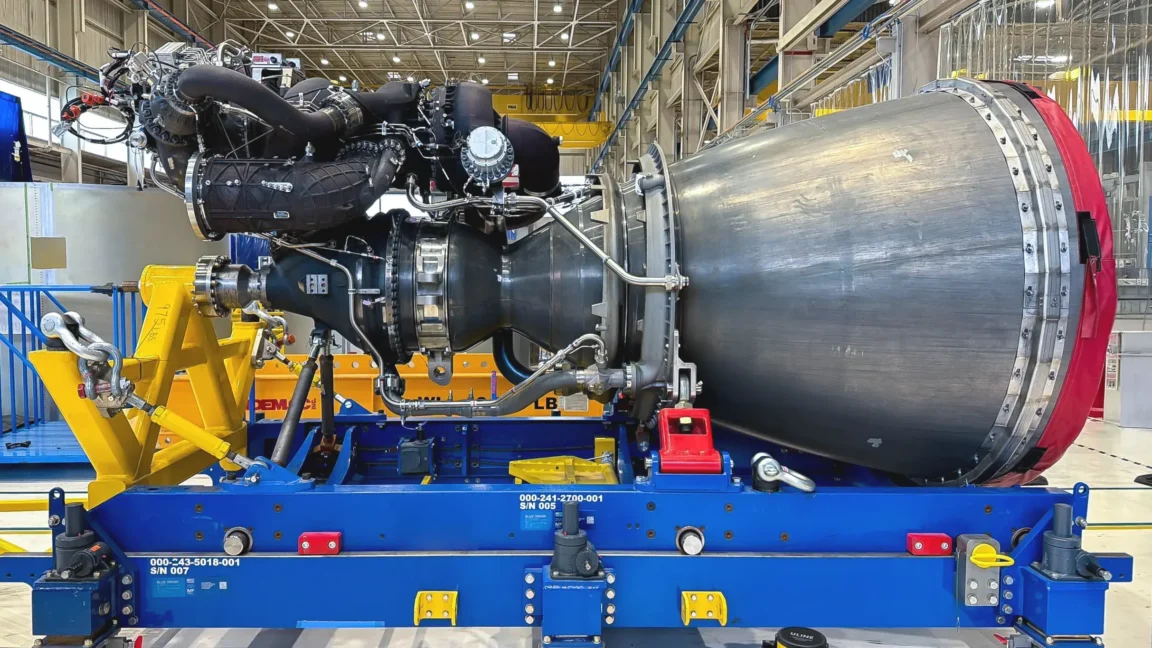
At the center of the effort is Northstar, a new engine already in test firing. It will eventually replace the BE-4 that powers New Glenn’s first stage. According to Limp, Northstar is a simplified but more powerful version of BE-4. It has half the number of parts, 30 percent less mass, and about 65 percent can be 3D printed.
Blue Origin believes it can build Northstar at 25 percent of the cost of a BE-4. The company also thinks it can eventually reach a point where each engine is assembled in less than a day. It says it is deep into development and testing, with a test firing campaign already underway.
“To get access to space at a lower cost, we have to look at every part of the vehicle,” Limp said. “This is going to be a game-changer.”
The current BE-4 produces 640,000 pounds of thrust. Limp said Northstar will start at 715,000 pounds. Like BE-4, it burns methane and liquid oxygen and uses an oxygen rich staged combustion cycle with a single shaft turbopump architecture. Blue Origin will keep making BE-4 engines for United Launch Alliance, whose Vulcan rocket uses two of them.
Separately, Blue Origin is developing GS3, or Glenn Stage 3, to give New Glenn an additional boost. The stage is designed to offer direct injection to geostationary orbit and Earth escape trajectories. It fits inside an interstage, which preserves the full fairing volume for customer payloads.
GS3 can fly on the smaller 7×2 variant of New Glenn, which uses seven first stage engines and two second stage engines, as well as the larger 9×4 variant. With GS3, the 7×2 version can carry 8 metric tons directly to geostationary orbit and 10 metric tons to translunar injection. Those numbers rise to 14 tons and 20 tons, respectively, on the 9×4 variant.
Because it is a third stage, the vehicle has to be light. Limp said GS3 is made mostly of composites, which are high performing and lightweight. The stage will use the BE-7 engine, already employed on Blue Origin’s lunar landers. BE-7 is optimized for in space operations and burns liquid hydrogen and oxygen.
Hydrogen is the smallest atom, making it prone to leaks. With composites, thermal cycling and mechanical strain can lead to cracking, which can worsen losses of molecular hydrogen. Limp said Blue Origin was not certain that a large composite tank, one with a 5.5 meter diameter in this case, could be built to hold hydrogen at high pressures.
The company recently reported a breakthrough at Launch Site One in Texas. It completed its first tanking test of a composite liquid hydrogen tank. The tank was pressurized to 100 percent of the maximum force expected during operation for 2.5 hours. It was also successfully tested at 150 percent of that maximum pressure for 10 minutes.
That result gave Blue Origin confidence that a GS3 based on composite tanks could move forward. The company is now aiming for a debut in 2028 for a government customer.
“We have one customer signed up for cislunar space in 2028,” Limp said. “We are open for business.”
Blue Origin is pursuing the changes on two fronts: a cheaper, more powerful first stage engine and a lightweight third stage for farther destinations. With Northstar in testing and GS3 targeting a 2028 debut for a government customer, the company is tying its New Glenn upgrades to both cost and performance.