
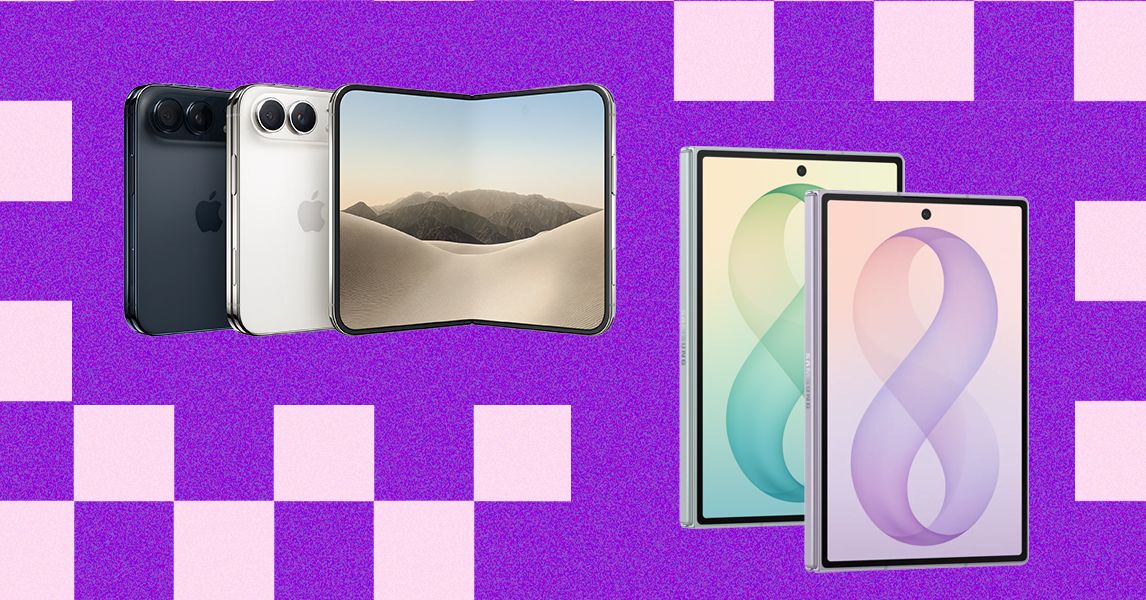
Folding phones are no longer a novelty sideshow. They have split into two clear shapes, the compact flip and the larger book style device, and the market now includes Apple alongside Samsung, Motorola, Google, Honor, Oppo and Xiaomi. The tradeoffs remain real, from higher prices to greater fragility, but the category has matured enough that buyers can choose a foldable for style, multitasking or simply a smaller pocket footprint. In its October 2026 update, WIRED added the iPhone Duo, more testing notes on the Galaxy Z Flip8 and updated prices. These are the models its reviewers recommend.
Samsung Galaxy Z Fold8: the best overall
The Galaxy Z Fold8 has new proportions that make the book style design feel purposeful. It is shorter and wider than earlier Galaxy Z Folds, and when opened it feels more like a tablet than before. The crease is much less visible than on previous models, and the Fold8 is lighter and easier to handle than the larger Fold8 Ultra. The loss of screen area is marginal.
The cover display measures 5.5 inches and uses a 10:16 aspect ratio that avoids excessive letterboxing. The inner screen is 7.6 inches. Testers found they opened it more often than the Ultra, and three apps can sit side by side in split screen. The Qualcomm Snapdragon 8 Elite Gen 5 chipset keeps apps and games running smoothly. A 4,800 mAh battery, Samsung’s first with silicon carbon technology, delivered about five to six hours of time with the screen on.
The camera setup is where the Fold8 gives ground to the more expensive Ultra. It has a 50 MP main sensor and a 50 MP ultrawide, plus two 10 MP selfie cameras for the outer and inner screens. The Ultra adds a 200 MP main camera and a 10 MP telephoto with 3X optical zoom, making it the better pick for photographers. The Fold8 still takes good photos for most people.
At $1,900, the Fold8 is expensive. The Ultra costs $200 more. Offers were already appearing at the time of the guide, and more are expected during the holiday season.
Apple iPhone Duo: a strong first foldable
The iPhone Duo is an unusually polished debut for Apple in the folding category. Testers praised its hardware, hinge and durability. The outer screen is large enough to be useful, and the device opens to a small tablet size. A nanotexture finish almost completely hides the crease. At 254 grams, however, it is heavy; the Fold8 weighs 201 grams.
Apps optimized for the inner screen can run side by side, and Apple has moved iOS navigation elements to the right, which works well in apps that use the layout. The Duo is a good choice for multitaskers, and it can even handle work. Battery life is excellent, with about 40 percent left after an average day.
Apple has added features that use the form. Kid Cue helps catch a child’s attention for photos. Smart Take lets you prop the phone on a table and shoot automatically when everyone is posed. Enhanced StandBy support turns the outer screen into an alarm clock while the inner display pulses with light to wake you. Apple Pencil support is due later in October.
The familiar compromises are present. There is no Face ID; Touch ID sits in the side power button. There is no telephoto lens. The camera system includes a 48 MP primary and a 48 MP ultrawide. Even with those limits, this is the first folding phone for Apple fans, and at a starting price of $1,999 it is likely to be popular.
Motorola Razr Ultra (2026): the best flip phone
Flip phones suit anyone who wants a device that fits in a pocket or small clutch. The Motorola Razr Ultra is compact and, in testing, the most fashionable smartphone available. Buyers can choose an Alcantara back that feels like suede or a sustainably sourced wood back; both look and feel good. The phone has an IP48 rating for some dust protection, a hinge reinforced with titanium, and Gorilla Glass Ceramic for durability.
Little has changed from the Razr Ultra 2025. It uses the same Qualcomm Snapdragon 8 Elite chipset, 512 GB of storage and 16 GB of RAM. The 4 inch OLED cover screen supports multiple widget panels, so users do not need to open the phone as often. Inside is a bright, colorful 7 inch AMOLED screen. The major upgrade is a 5,000 mAh silicon carbon battery that can last two days between charges and is large for such a small phone.
The 50 MP main camera produces great photos. There is a reliable 50 MP ultrawide and a 50 MP selfie camera. The camera is good but still does not quite match candybar phones from Google and Apple. A useful trick is taking a selfie with the phone closed and using the front screen as a preview. Video capture is also good, with Dolby Vision support that keeps clips sharp and colorful and limits grain in low light.
Motorola promotes a long list of AI features and even includes a dedicated AI button. Most of them are not very helpful, according to testing. Pay Attention was the only one regularly used; it starts a recording with real time transcription and an AI summary at the end, but many flagship phones now do the same. The Razr Ultra is worth buying for its design, not for Moto AI. It costs $1,500.
Motorola Razr (2026): the best budget foldable
Cheaper folding phones require compromises. The standard Razr has a design similar to the Ultra but with slightly smaller screens. It uses a slightly upgraded MediaTek chipset and less RAM, so performance is slower but not frustrating. It has the same hinge reinforced with titanium as the Ultra and an IP48 dust and water resistance rating.
The camera remains solid and produces pleasing shots in good conditions, though it struggles in low light and high contrast scenes. The outer display is smaller but still customizable. Battery life is good and can last a couple of days when needed.
Only three Android upgrades are promised, which is disappointing. The Razr also carries the same unimpressive Motorola AI features as the Ultra. At $800, it is the most affordable way to try a folding phone while still getting a worthwhile package.
Google Pixel 11 Pro Fold: durability and Android polish
The Pixel 11 Pro Fold is a polished update to Google’s line with several small improvements. It is one of the few folding devices with an IP68 dust and water resistance rating and can withstand 10 years of folding, which may make it the most durable option. It is also the only Android folding phone with Qi2 25W wireless charging, so it can attach magnetically to MagSafe or Qi2 chargers.
Even with a slimmer body, it is noticeably thicker and heavier than Samsung’s folding phones, which makes it more cumbersome. Its battery is smaller than last year’s model but still lasts most days, largely because the Tensor G6 chipset is more efficient. Google added Floating Bubbles for multitasking, allowing an expandable chat to float over two other apps in split screen. Gemini also gets enhancements, including contextual popups in chats that can add links to the calendar for events or open destinations in Maps.
Despite the Pro name, the Fold lacks most of the Pro features found in the cheaper Pixel 11 Pro and Pixel 11 Pro XL. It does have HiLight, a group of color LEDs in the camera flash that light up based on who is calling or while chatting with Gemini. It misses the more powerful camera system and features such as instant Night Sight, 120X digital zoom and better video capture. Photos are excellent, but not the best Google offers. That is hard to accept at $1,900.
Honor Magic V6: the best book style foldable outside the US
The Honor Magic V6 has a sizable camera bump, but the rest of the body is very slim: 4.1 mm open and 8.8 mm closed. It is easy to handle and feels close to a regular phone when closed. It improves on the Magic V5 with better battery life, faster charging and greater durability. It also has a versatile camera and a responsive fingerprint sensor in the power button. MagicOS includes potentially useful folding and AI features, along with some bloatware.
The biggest change is a 6,660 mAh silicon carbon battery. Honor promises better durability than before, with an IP68/69 rating for water resistance. A new red finish is available. The Magic V6 is the best book style foldable for buyers in the UK, Europe and other markets where it is sold, though it can be imported into the US.
Other foldables worth knowing
Samsung Galaxy Z Fold8 Ultra, $2,100: The Fold8 Ultra has a 6.5 inch cover display and an 8 inch inner screen that feels like two 6.5 inch displays side by side. It is fast and smooth, with a 5,000 mAh battery. The camera earns the Ultra name: a 200 MP main shooter, 50 MP ultrawide and 10 MP telephoto with 3X optical zoom. It lacks Qi2 support for magnetic wireless charging, and the camera module makes the phone rock when it lies flat. The smaller Fold8 is easier to handle, which is why the Ultra does not rank higher.
Samsung Galaxy Z Flip8, $1,200: The Z Flip8 is the lightest and thinnest flip phone in the world, with a redesigned chassis. It comes a close second to the Razr Ultra. It has a 4.1 inch cover screen and opens into a 6.9 inch candybar. It is more durable than earlier models and has the same chipset and performance as Samsung’s larger Fold phones. The 4,300 mAh battery is solid, but the camera setup is basic: a 50 MP main shooter and a 12 MP ultrawide.
Motorola Razr Fold, $1,900: Motorola’s first book style foldable is good but not great. The front screen feels like a normal phone, and the 8.1 inch inner display is vast. It lacks the top processor of the year, which is disappointing at this price. Its highlight is a 6,000 mAh battery that can stretch to nearly three days. It comes with seven years of software updates, unlike Motorola’s flip family. Motorola also added a telephoto lens to a capable triple 50 MP camera. Overall, the Pixel 11 Pro Fold is preferred.
Motorola Razr+ 2026, $1,100: The Razr+ is an awkward middle child. It lacks the top specs of the Ultra but costs more than $1,000. The cheaper Razr gets very close and saves hundreds. Battery life is unimpressive because it has the smallest capacity in the Razr family. The cover glass is not the ceramic mixture used on the Ultra. In testing, a roughly 4 foot drop onto asphalt shattered the front screen. A screen protector is a good idea.
Oppo Find N6, $1,929: The Find N6 has an 8.12 inch internal display and is beautifully engineered, slim and light. It promises to be creaseless, but the fold is still discernible. It is hardly noticeable when the screen is on, though it can be felt with the optional stylus. Performance is slick, battery life lasts a busy day, and the camera system is excellent. It steps up from the N5 with a 200 MP main shooter, 50 MP telephoto and 50 MP ultrawide. The global model can use familiar Google apps, but the phone must be imported and will not officially be released in the West.
Google Pixel 10 Pro Fold, $1,799: The Pixel 10 Pro Fold is worth considering only on sale. The Pixel 11 Pro Fold is superior, but the 10 Pro Fold is not far behind. It is reasonably slim, with a large front screen that feels like a normal phone, an excellent 8 inch inner screen and a triple camera system that delivers great results, though not as great as the Pixel 10 Pro series.
Xiaomi Mix Flip, $899: Xiaomi’s first flip phone has a lovely design, excellent displays inside and out, long battery life with fast charging, and flagship level performance. It has a solid dual lens camera with a telephoto instead of an ultrawide alongside the main shooter, which is more useful for most people. Software lets the package down a little, there is no IP rating, and it is pricey, but it is a fun flip phone.
What to know before buying a folding phone
Folding phones are more fragile than normal phones. They have more parts, including a hinge. Companies advertise tests of around 200,000 or 500,000 folds, but a single drop can cause serious damage. They are not as dust resistant as regular phones, and some are not as water resistant. In the US, only the Pixel 11 Pro Fold and iPhone Duo have an IP68 rating. Buyers should use a case and may want the manufacturer’s device care policy.
Do not remove the screen protector that comes installed. Most folding phones have a film over the inner screen. Removing it can damage the display. Packaging usually includes instructions not to remove it and explains how to care for the device.
There is a small learning curve to the software. Flip phones are fairly straightforward, but book style folding phones that double as tablets have new multitasking tricks. Taking time to learn those features helps users get the most from the device.
Folding phones are expensive. Nobody needs one. Buyers who expect to benefit should know that discounts are common during big sale events such as Black Friday, and trading in an eligible device can knock a few hundred dollars off the price.
Which type of folding phone is for you?
Flip phones are for people who want a compact device. They are normal phones that fold in half, with a front screen for widgets and messages. Users can flip the phone open to answer a call and shut it to end one. At 90 degrees, some apps adapt to show controls on the bottom and important details at the top, as in video calling apps or YouTube, though support depends on the phone. Flip phones often have mediocre battery life, and their cameras are not as good as those on phones that do not fold.
Book style phones are for people who want a big screen. They suit those who watch full length movies on a phone or jump between two apps. They have good battery life and better cameras than flip phones, though still not as good as phones that do not fold, and they are far more expensive. The category includes short lived triple screen devices such as Samsung’s Galaxy Z TriFold. They are thick and heavy, though newer models are surprisingly thin. They can still be hard to fit in a pocket.
Android buyers have good timing. Samsung and Google have just updated their foldables, and Motorola released its first big foldable in the summer. Motorola will not announce the Razr 2027 lineup until the spring. Outside the US, new foldables from Honor and Oppo are not expected until the spring either. iPhone buyers may want to wait because Apple is likely to unveil a new folding phone soon.
One of the most useful folding phone tricks is the external screen viewfinder. It lets users take a selfie with the rear cameras by setting the phone down slightly folded so it stays upright, then sending the preview to the outer screen. A palm gesture can usually trigger the shutter without touching the phone. The Razr Ultra also supports hand gestures for starting and stopping video. The feature is excellent for travel photos at a point of interest.
Translation is another practical use. Samsung and Google, for example, can show translated words on the external screen for the person being spoken to. That person can tap a button to have their words translated on the internal screen. It is a nicer system than using Google Translate on a candybar phone.



