
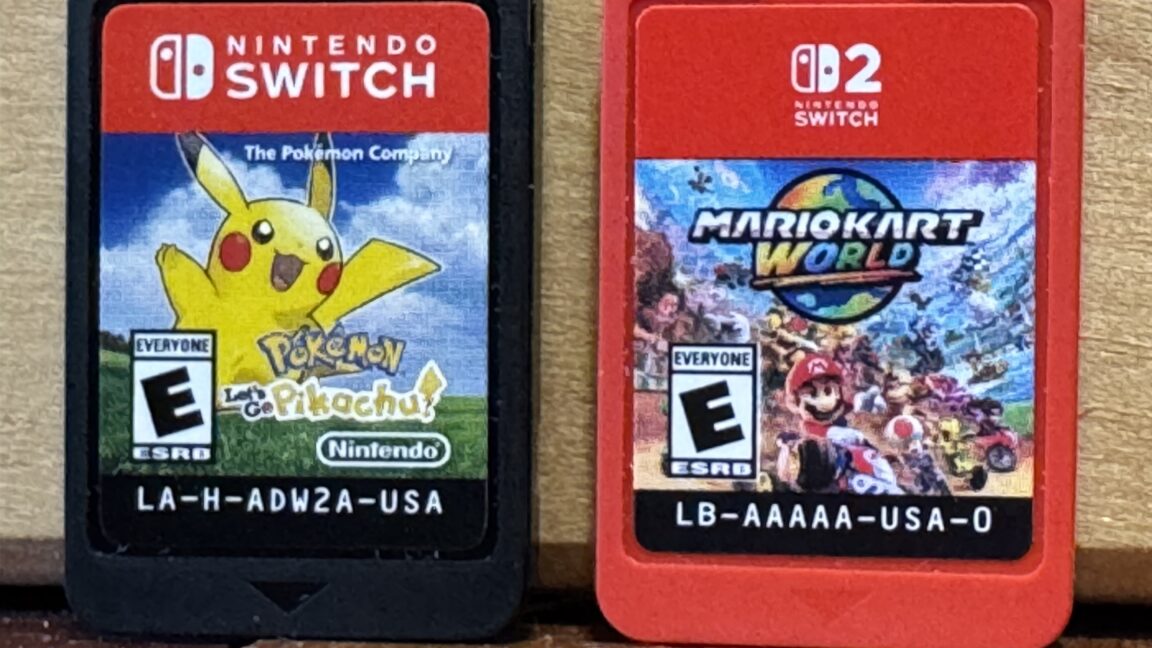
Nintendo’s biggest ROM chip supplier is preparing to leave the game industry. Macronix said in its earnings report for the third quarter that ROM production “has reached its end” and that it will begin “gradually decoupling from the game industry,” according to Taiwanese news site BigGo Finance. The move puts fresh attention on the supply chain behind Nintendo’s physical Switch cartridges, where analyst David Gibson identifies Macronix as Nintendo’s “main memory chip maker.”
ROM production has shrunk 39 percent over the last year and now represents just 5 percent of Macronix’s business, the company said. More lucrative and in demand products, including memory built on NOR and NAND technology and eMMCs, are crowding it out. Macronix’s production capacity is fixed at 25,000 12-inch wafers a month, while $1.2 billion in planned new capacity will take a year or more to bring online. In that setting, less profitable ROM chips use wafer space that could earn more from other products.
The supply shift does not mean Nintendo will follow Sony into a world without physical game production. Nintendo said last month that it had no plans to give up on game cartridges in the near future. Still, those cartridges could become more expensive to produce if the company has to lean on suppliers such as Rohm and Lapis Semiconductor for its remaining ROM chips.
That could have an effect on the prices publishers charge for physical Switch cartridges. Earlier this year, Nintendo started charging more for some physical games than for the equivalent digital download. Last year, Japanese publisher Inin only committed to a full Switch cartridge release for R-Type Dimensions III after it said “two new smaller cartridge [storage capacity] sizes for Nintendo Switch 2” lowered the cost of producing those carts.
There is a counterweight in Nintendo’s software mix. Gibson notes that digital software sales represented 61.5 percent of Nintendo’s business in the second calendar quarter of 2026, up slightly from the year before. If that number keeps increasing, lower demand for ROM based Nintendo cartridges could end up balancing out the costs involved in due time.
Nintendo has said it has no plans to abandon cartridges in the near future, and its digital business continues to grow. Even so, Macronix’s retreat from ROM production leaves the company more dependent on other suppliers at a time when physical cartridge costs are already under pressure.



