For Manx shearwaters, a long foraging trip across the North Atlantic can come with a navigational side effect. A new study published in Science finds that the seabirds can experience a kind of jet lag during their journeys, and that the time shift leaves a measurable bend in the Sun compass they use to find their way home.
A Bird Built for Distance
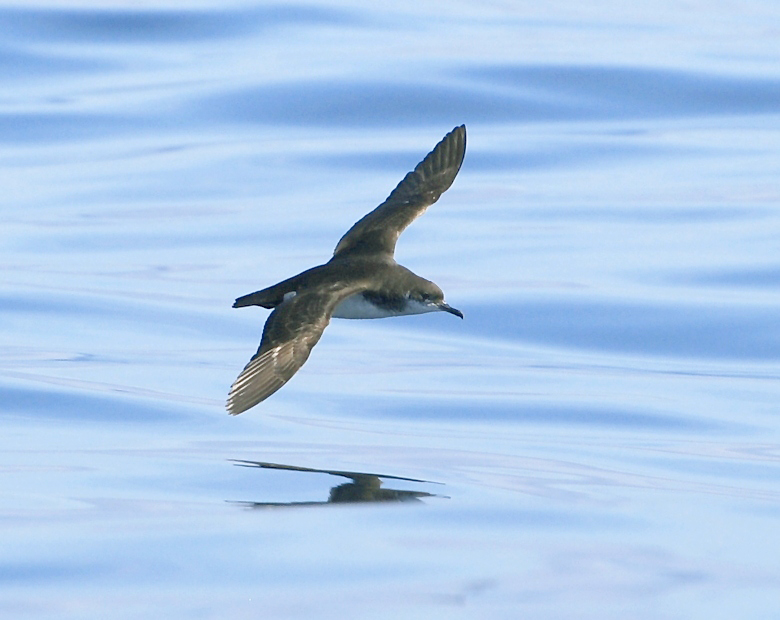
Manx shearwaters are built for distance. The birds, which can cover hundreds of kilometers a day over the North Atlantic, nest in burrows on coastal islands around the North Atlantic. Most breed around the UK and Ireland, with about half the population living in Wales. From those colonies, they fly out to feed anywhere from a few dozen to more than 1,000 kilometers into the Atlantic. To return, they are thought to work out where they are using a map sense, possibly based on smells, and then use the Sun as a compass to set their direction.
Patrick Lewin, a behavioral and sensory ecologist at the University of Oxford and lead author of the study, described the species in simple terms. “Manx shearwaters are medium-sized birds, about the same size as a pigeon,” Lewin said. “They are white underneath and black on top, but they have very long wings, and they are closely related to albatross.”
Navigating by the Sun is not as simple as keeping a fixed angle to it. The Sun moves across the sky, so a bird needs an internal clock that tells it what time of day it is. Lewin offered a human scale example.
“You can imagine an animal or a human that wants to travel south all day. At sunrise, when the Sun’s in the east, it needs to be traveling 90 degrees clockwise of the Sun, but by midday it needs to be traveling straight towards the Sun, and by sunset it needs to be traveling 90 degrees anticlockwise of the Sun,” Lewin said.
Birds, like nearly all animals, have such a clock. The Manx shearwater’s clock is imperfect. The birds recalibrate it at every dusk and dawn, which means that for every degree of longitude they cross between sunrise and sunset, their clock falls four minutes out of sync with local time. As a result, a shearwater misjudges where the Sun should be. It veers off course clockwise when it flies east, or anticlockwise when it flies west.
Two Decades of Tracks
Similar effects had been shown in other birds by catching penguins and moving them quickly across lines of longitude. Before Lewin’s study, however, no one had clearly demonstrated the effect in wild animals moving on their own. The bias is small, so it takes a large amount of data to become apparent. Lewin’s team happened to have exactly that.
Tim Guilford, Lewin’s supervisor at Oxford, and Chris Perrins, a longtime Oxford shearwater researcher, started fitting the birds with GPS tags in 2004, when the devices first became small enough for a bird this size. Two decades later, the team had tracks from 3,688 foraging trips made by 1,045 birds from colonies along the UK’s western coasts. The trips lasted from one day up to two weeks.
From that dataset, the researchers separated homeward flights. That part was fairly simple. Foraging shearwaters make short, wiggly flights between dives. The trip home looks different.
“When they are deciding to go back to their colony, they kind of switch into this mode where they are flying as fast as they can in pretty much a straight line continuously without stopping for really long periods,” Lewin said.
For each homing flight, the researchers worked out where the bird last saw sunrise, the point at which its clock should have matched local time. Then, at every GPS fix, they calculated how far east or west the bird had traveled since then and how much that would bend its Sun compass. Because they knew each bird was headed exactly to its burrow, they could compare those predictions with the bird’s actual deviation from its course.
A Small Bias With a Measurable Effect
The time shifts were tiny. “About an hour is pretty much the maximum that we observed. Most of these are probably 15-minute, 10-minute time differences,” Lewin says. “For us, that would be pretty imperceptible, but it does still have an effect on their compass orientation that we can detect.”
Across 335 homing flights made out of sight of land, the birds veered just as the Sun compass predictions said they would. Because the study was not a controlled experiment, Lewin argues that causality needs careful handling. Still, the team calculated the biases that crosswinds, the Coriolis effect, or a magnetic compass might introduce. None of those fit the data well.
“Our observed biases match by far the best to the Sun compass biases that we would expect,” Lewin said.
The navigational errors apparently caused by jet lag reached up to around 15 degrees. For birds with a map sense, that was far less costly than it might sound. A shearwater can check its position, notice that it is drifting, and correct. The team calculated that for a bird flying 1,000 kilometers east in a day, about the maximum the researchers observed, the average error would be roughly seven degrees. If the bird keeps checking where it is, that adds only five kilometers to the trip.
The researchers also found that when shearwaters followed coastlines, they still drifted slightly closer to or farther from the shore depending on their expected compass error. Work done at Oxford two decades ago showed that homing pigeons with shifted clocks do the same, even while following a familiar road. That led researchers to hypothesize that birds may run two parallel navigation systems, one based on the compass and one on familiar landmarks, with the balance between them never tipping entirely to one side.
Lewin suggests an alternative. The birds may not know exactly where on the coast they are and may use the Sun to pick which way to follow it. “We don’t quite know. And I think it’s an interesting question, especially as people try and design bio-inspired autonomous navigation systems,” Lewin says.
Questions That Remain
The study could not answer whether Manx shearwaters suffer from other jet lag symptoms, such as poor sleep or hunger at odd hours. “We’ve not been able to investigate that yet,” Lewin said. His team’s next step would be to find out whether the time shifts affect when the birds forage, how much food they bring home, and their breeding success.
Another question is whether more animals routinely experience jet lag. Lewin thinks that is quite likely. The same effect could hit any organism with an internal clock that moves far enough east or west in a single day. That mostly means fliers, or animals living near the poles, where lines of longitude are packed closer together. The long term goal is to find out whether animals that constantly suffer from jet lag have evolved ways to cope with it.
“In humans, if you do it a lot, in the long term it has really negative health impacts,” Lewin said. “So maybe we could take some inspiration from these animals that are constantly experiencing jet lag and see if there are ways that we can mitigate jet lag affecting humans.” The study was published in Science in 2026 under DOI 10.1126/science.adz2542.