United Launch Alliance is aiming to send its Vulcan rocket back into flight on Friday the 13th, with 40 Amazon Leo broadband satellites aboard and a launch date that still depends on range approval. The flight is a high stakes moment for ULA after booster nozzle failures on two of the rocket’s first four missions drew close scrutiny from the US Space Force, its primary customer.
The mission is scheduled to lift off from Cape Canaveral Space Force Station in Florida. It will be the first of 38 Vulcan flights Amazon has booked to deploy the bulk of its Leo network. Amazon Leo is a potential competitor to SpaceX’s Starlink network.
Booster failures and scrutiny
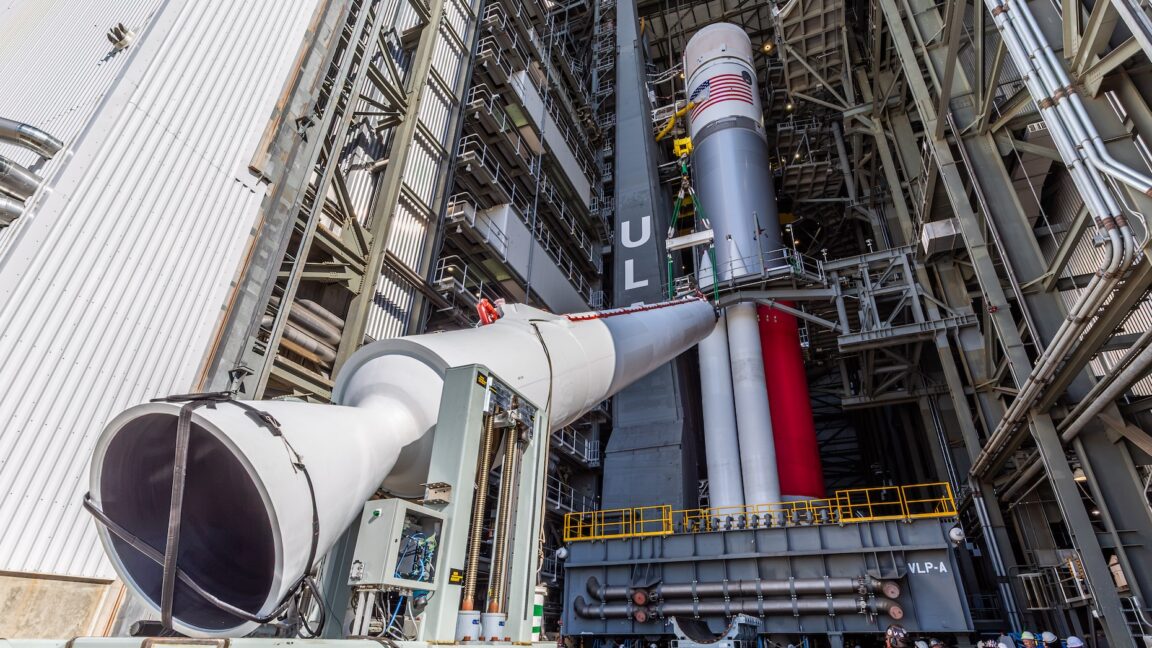
The launch is critical for ULA after its new flagship rocket suffered nozzle failures on its solid rocket boosters on two of its first four missions, most recently during a flight in February. In both cases, the rocket overcame the nozzle failure and completed its mission, but officials at the US Space Force, ULA’s primary customer, lost confidence in Vulcan.
Space Force officials will closely scrutinize the return to flight mission. The Pentagon has entrusted ULA’s Vulcan rocket with roughly half of its major launches through the early 2030s. The Space Force certified Vulcan for national security launches in 2025, then flew two missions on the rocket before its grounding after the February booster incident.
In a statement, United Launch Alliance said engineers “made great strides” in understanding the booster anomaly that occurred in February. Engineers “have identified several potential contributors, which have been mitigated through design and process improvements to the nozzle,” ULA said.
“To support our customers, this upcoming launch will utilize the improved nozzle design, and additional testing and analysis will continue in parallel with the mission,” ULA said. “By flying the improved design, ULA gains valuable flight data that validates these improvements and is the most beneficial path in support of all our customers.”
ULA and Northrop Grumman, the booster manufacturer, have not publicly identified the root cause of the nozzle malfunction in February. Investigators blamed the nozzle problem’s first occurrence in 2024 on a manufacturing defect in an insulator meant to protect the nozzle’s metallic structure from the rocket’s superheated exhaust. Neither company responded to questions from Ars on Wednesday.
The Space Force is counting on United Launch Alliance, a joint venture split evenly between Boeing and Lockheed Martin, to deliver a backlog of military communications, navigation, missile warning, and surveillance satellites into orbit. Amazon Leo also has an inventory of broadband satellites in storage waiting for rides on Vulcan.
Launch swaps and military missions
With ULA’s delays, the Space Force has moved six missions off Vulcan to expedite their launch on SpaceX Falcon 9 and Falcon Heavy rockets. ULA received six future missions originally assigned to SpaceX, the military’s other certified launch provider.
The swaps included three GPS satellites that moved off Vulcan for launches last year and earlier this year on SpaceX Falcon 9s. Space Systems Command, which oversees military launch acquisition and procurement, also swapped one ULA launch for the Space Development Agency with another SpaceX launch.
A launch carrying the Air Force Research Laboratory’s Oracle-M lunar mission will now fly on SpaceX’s Falcon Heavy rocket instead of Vulcan, which will receive a future launch from SpaceX in compensation. Space Systems Command completed a similar swap to move a large strategic missile warning satellite from Vulcan to Falcon Heavy.
So far the swaps have had no effect on the number of missions the Space Force has awarded to ULA and SpaceX. The trades are separate from the Space Force’s assignment of unallocated future missions to launch providers, a process that may already be hamstrung by SpaceX’s plans to retire the Falcon rocket family.
“These swaps are executed in coordination with and with the support of both launch service providers,” a Space Systems Command spokesperson said. “We are grateful for the flexibility shown by our launch service providers during these swaps to help us ensure we can deliver capabilities to the warfighter when and where they are needed.”
Brig. Gen. Eric Zarybnisky, the chief rocket buyer at Space Systems Command, said the military wants to see data from commercial flights on Vulcan before clearing ULA to resume national security launches. At least two Amazon Leo missions are on the Vulcan launch schedule before it flies another national security mission, perhaps early next year.
“Those flights will have a significant number of solids,” Zarybnisky said. “It’ll depend a lot on what we see, not only on the engineering and tests that we’re doing on the ground, but also what we see from the flight data from the commercial missions they fly.”
The upcoming Vulcan launch will be the first to fly with a full complement of six solid rocket boosters. The flight will also debut an extended payload fairing to accommodate Amazon’s satellite stack and a shortened Centaur upper stage optimized for low Earth orbit missions.
For ULA, the Friday the 13th launch is more than a commercial delivery mission. It is a public test of the fixes to its booster nozzles, a data gathering flight for the Space Force, and a long awaited start to Amazon’s plan to build out the Leo constellation. The mission remains contingent on range approval.