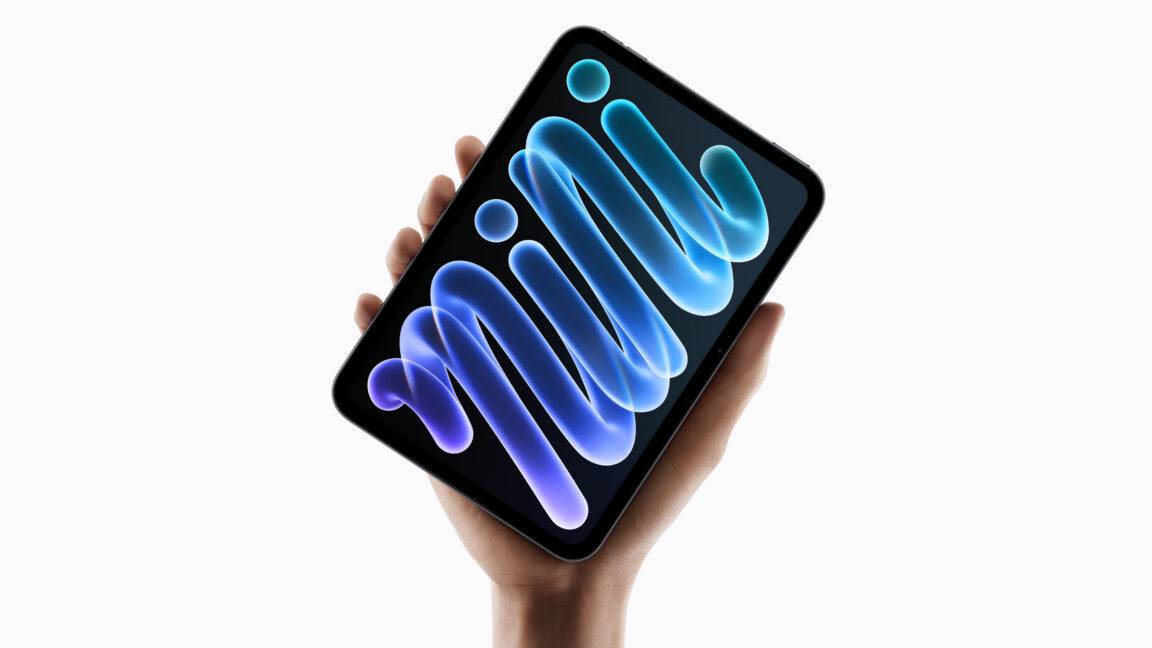
Apple has updated the iPad mini, and the most noticeable change is the screen. The company’s smallest tablet now uses an OLED panel for the first time, arrives in a thinner body with an official water and dust rating, and starts at $699.
The new iPad mini keeps roughly the same footprint as the 2024 model, but the display grew slightly because Apple cut bezel thickness by 24 percent. The chassis measures 5.4 mm, almost a full millimeter less than the last iPad mini. It also carries an IP67 rating for water and dust protection, something the seventh generation model never had, since it shipped with no official IP rating at all.
An OLED panel aimed at Pro territory
The 8.5 inch Super Retina XDR display replaces the 8.3 inch IPS panel used previously. Peak brightness rises from 500 nits to 1,200 nits, and the screen can drop to a 1 nit minimum so it remains comfortable in a dark room. Buyers bothered by reflections can pay extra for a nano-textured matte finish. Apple’s pitch is that the viewing experience now sits far closer to what its Pro level devices deliver.
Performance that varies by storage tier
Inside, Apple has moved to the 2 nanometer A20 Pro, the same chip that appeared in the iPhone 18 Pro. The upgrade matters because the previous iPad mini ran a 3 nanometer A17 Pro that was already a year old when it reached the tablet. Testing of the iPhone 18 Pro found the A20 Pro produced a significant gain in graphics performance, helped in part by a 50 percent increase in memory bandwidth.
Faster memory also assists AI features running on the device, although the Neural Engine does most of that work. Here the lineup splits. Apple says the 512GB configuration gets the dual 16 core Neural Engine found in the iPhone 18 Pro, while the 128GB and 256GB versions carry a single 16 core NPU. Those smaller capacities also use a slightly different CPU layout, with five cores instead of six.
Camera shift and the price ladder
Both cameras stay at 12MP, but the front sensor has moved. Rather than sitting on the short edge for portrait orientation video calls, it now sits on the long edge. Anyone who uses the tablet for FaceTime regularly may need a little time to adjust.
The $699 entry point buys 128GB of storage and Wi-Fi connectivity. Stepping up to 256GB costs $100 more, and 512GB costs $300 more. The nano-texture display adds another $100 and is available only on the 256GB and 512GB models. A cellular version of the 128GB model will run $849.
None of those figures are especially startling for 2026, but the tablet continues a pattern of rising prices at Apple. The seventh generation iPad mini launched at $499 in 2024 and has since climbed to $599. The new model adds another $100, though it does bring a set of meaningful upgrades in return.
Preorders open at 10:10 am PT on Wednesday, October 28, and devices will reach customers and store shelves on November 6.
The refreshed iPad mini trades its older IPS panel for OLED, gains a thinner chassis and an IP67 rating, and picks up the A20 Pro chip, with the top storage tier getting the fullest version of that silicon. The tradeoff is a starting price of $699, $100 above the current model, with preorders beginning October 28 and availability set for November 6.