
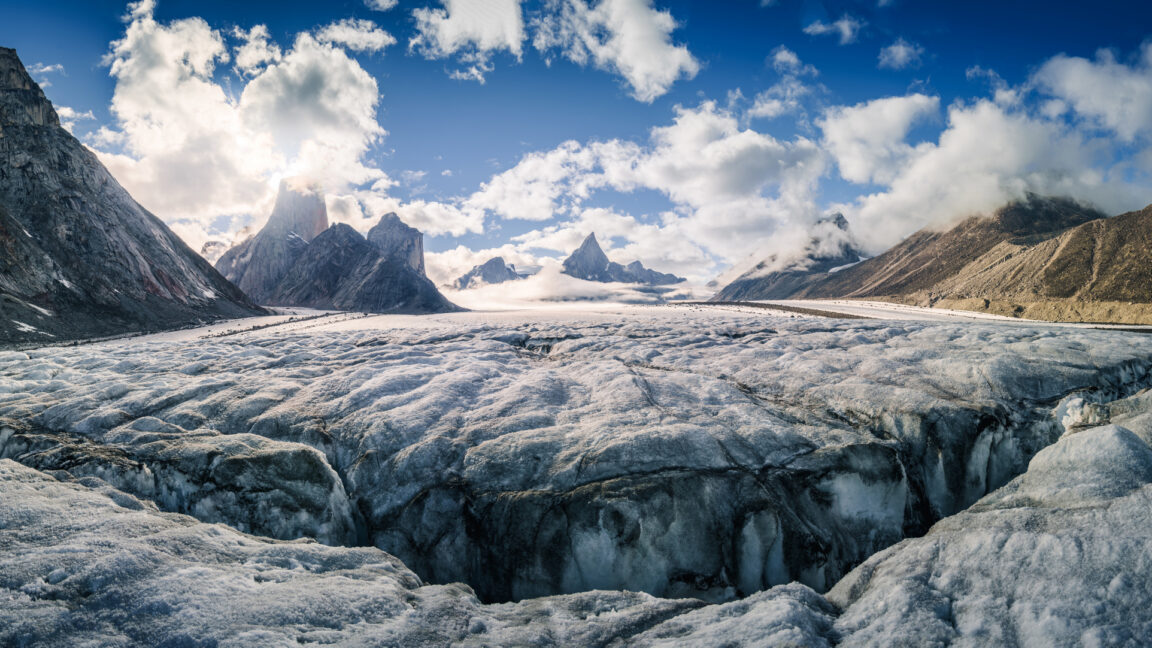
A new study in Science suggests the Laurentide Ice Sheet began growing again about 2,000 years ago, a possible opening phase of the next glaciation, before warming caused by humans reversed the advance around 1960. The research centers on Barnes Ice Cap, a remnant of the ancient ice sheet that preserves an unusual record of plants and rock beneath it.
The study concludes that the Laurentide Ice Sheet reached its smallest extent about 3,600 years ago and then began to re-expand roughly 2,000 years ago. The authors interpret that regrowth as the opening phase of the next glaciation. According to their evidence, the advance continued until about 1960, when warming caused by humans reversed it.
Nicolás Young, a geologist at Columbia University’s Lamont-Doherty Earth Observatory and the study’s lead author, describes Barnes Ice Cap as the last remaining piece of one of the Laurentide’s domes. As the huge dome thinned during the Holocene, its edge retreated onto Baffin Island. What remains today, he says, is the deflated core of ice that was once two miles thick.
Barnes can preserve a record of its own history because of conditions at its base, Young explains. Most glaciers are warm-based: meltwater at the bed allows them to slide, and the moving ice grinds away the material beneath it, erasing the record. Barnes is cold-based, frozen directly to the bedrock, which keeps it from sliding.
‘If there is an ice event where you live and you have to go and scrape off your windshield, that ice that’s plastered to the windshield of your car, that’s a good example of how cold-based ice operates. It’s sort of just stuck to what it’s on,’ Young said.
Ice stuck in that way protects the ground below instead of eroding it. As the Laurentide retreated across the plateau, tundra plants colonized the newly exposed ground. When the ice returned later, it covered the plants where they stood and kept them intact for two millennia.
To date the turnaround, Young’s team used two independent methods. The first measures beryllium-10, an isotope that builds up in the top few centimeters of rock exposed to the sky. By sampling the upper surface of a boulder and counting the isotope, researchers can determine how long the rock has been uncovered. That method dated the ice sheet’s retreat and indicated that the Laurentide had withdrawn to within today’s ice margin by 3,600 years ago. It probably shrank further by around 3,000 years ago.
The second method relied on the dead plants. ‘There were all these plants growing, just like today. And included in that are mosses, these little mosses that are rooted in the ground,’ Young said. ‘So they’re there, they’re living their life, and eventually the Laurentide Ice Sheet starts to re-expand. And when that ice margin covers the moss, it literally kills it.’
Radiocarbon dating of moss remnants gives the time of death, which glaciologists call a kill date, meaning the moment the ice reached that spot. By combining kill dates from moss samples at different locations, the scientists reconstructed a map of an advancing ice margin.
About 70 percent of the team’s radiocarbon dates cluster around 1800 CE, at the culmination of the Little Ice Age. ‘It’s all sort of the same thing,’ Young said. The Little Ice Age was the point when Northern Hemisphere glaciers were at their most extensive in recent millennia. At Barnes, Young argues, the expansion was one late pulse within an advance that had been underway for 2,000 years.
The plants that matter most to Young’s team are still under ice. Barnes’ margin has retreated 200 to 800 meters since 1960, exposing mosses killed from about 1000 CE onward. Older material remains buried. To find the exact moment the advance began, the team looked at nearby ice caps.
Other small ice caps on the same plateau are close enough to share Barnes’ climate. Earlier studies collected nearly 200 kill dates from beneath them, and none is older than 2,000 years. ‘What that means is that all of those ice caps up there didn’t start advancing or re-expanding until about 2,000 years ago,’ Young said. ‘Since the Barnes Ice Cap is right next door, it’s probably a good bet that it also started expanding 2,000 years ago.’
Young argues that continued retreat of Barnes Ice Cap should eventually expose the decisive samples. ‘If we went back there in 20 years or something, as the ice margin has retreated a little more, we actually might be able to sample those 2,000-year-old plants,’ he said.
According to the study, the ice began to re-expand at that moment because two global forces were pulling in opposite directions, and one eventually prevailed. Solar energy reaching high northern latitudes peaked about 10,000 to 11,000 years ago and has declined since, pushing the planet toward the next ice age. At the same time, atmospheric carbon dioxide rose by roughly 20 parts per million between 8,000 and 2,000 years ago, strengthening the greenhouse effect and warming the atmosphere.
‘That drop in insolation and temperatures actually overwhelmed the small temperature forcing the little bit of carbon dioxide rise over the same time span,’ Young explained.
Eventually, about 2,000 years ago, temperatures fell far enough because of reduced sunlight at high latitudes, and the carbon dioxide effect was not strong enough to prevent ice sheets from expanding again. The finding comes despite calculations of orbital forcings and modeling of how carbon dioxide affects glacial inception, which have suggested the next ice age was postponed by tens of thousands of years. Young argues that there is no real contradiction between those models and the field evidence.
‘A lot of people have defined glacial inception as glaciers and ice sheets needing to be of a certain size, big enough that we’ll say, ah, yes, we are into the next ice age,’ Young said. ‘And that’s perfectly reasonable, because until now there’s been no way to actually pinpoint when an ice sheet first turns around and starts to expand.’
In geological terms, human influence entered the picture soon after the Laurentide began to grow again. Greenhouse gases rose by about 12 parts per million between 1750 and 1850, by another 50 parts per million by 1960, and by a further 138 parts per million by 2024.
‘Once we hit the Industrial Revolution, we’re now pumping way more carbon dioxide at a magnitude that has never occurred in the geologic record,’ Young said. By 1960, Barnes’ mass balance turned negative and its advance ended.
Today, Barnes Ice Cap is dying. In the 1960s and 1970s, roughly 35 percent of its surface sat above the area’s snow line. By the early 2000s, about 3 percent did. Today, none of it does.
‘This means in the summer, it’s all melting. There’s no more accumulation zone. There’s no more new ice forming,’ Young said. ‘An ice cap or glacier cannot survive if it does not have an accumulation zone.’ According to his models, Barnes will disappear within a few centuries under any plausible emissions scenario.
Asked whether warming the climate quickly allowed humanity to dodge an ice age, Young said that no one in modern times wants to live in an ice age climate, which would be hard and very different. He argues, however, that humans did not exactly do themselves a favor. Reaching a true, full ice age climate with large ice sheets would have taken several tens of thousands of years.
‘I would argue that the pumping of greenhouse gases into the atmosphere hasn’t really saved us from anything,’ Young said. Instead, he says, humans interrupted a cycle that was very old and very regular.
‘The pacing of ice ages over the last 2.5 million years has been one of the most consistent cycles in the Earth system that we have,’ Young said. ‘We have evidence now that humans, and specifically greenhouse gases, have actually terminated one of the most consistent cycles on Earth.’
The study is published in Science: https://doi.org/10.1126/science.aed3379



