
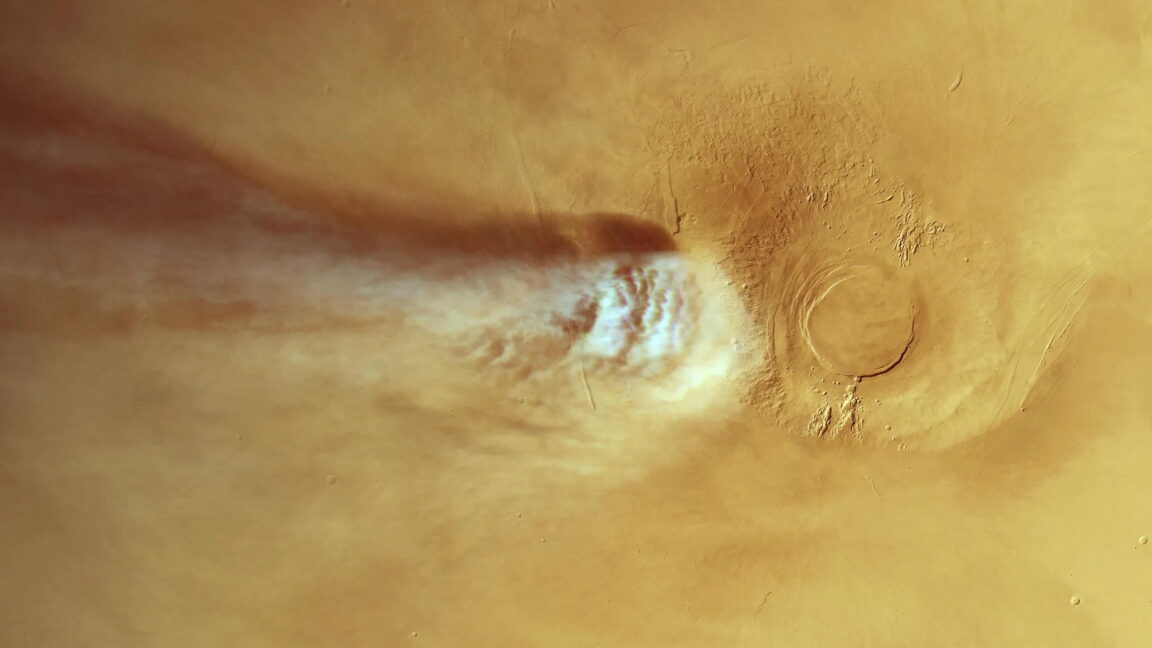
A cloud that can stretch about 1,000 miles across the Martian sky has puzzled scientists since a probe first photographed it in 2018. Now a team of researchers says it may be produced by a process that has never been directly observed in the atmosphere of any planet.
Since the Arsia Mons Elongated Cloud, known as AMEC, was first recorded by a probe in 2018, scientists have been unable to find a plausible explanation for how it comes to exist. That has now changed. Researchers have modeled the cloud’s formation for the first time, and their results suggest it is driven by a physical process that, while described in textbooks, has never been seen at work in nature.
“We found that we needed to include some exotic physics… physics that, while included in textbooks, is treated as theoretical and usually thought not to happen in nature. It certainly hasn’t been seen in action before,” Jorge Hernández-Bernal, a planetary scientist at Paris’ Sorbonne Université and lead author of the study, said in a press release. “Once we included this physics in our simulations, the AMEC emerged just as we hoped.”
Clouds on Earth usually take shape when water vapor forms droplets or ice crystals in the presence of tiny particles such as dust or salt. The new study, published in Nature Geoscience, proposes something different for AMEC: homogeneous nucleation, in which vapor turns directly into ice crystals on its own, without any debris to seed it.
A cloud that forms without seeds
“It’s akin to droplets of condensation appearing in the middle of a room, rather than on a window,” Hernández-Bernal explained. “It’s wholly unexpected.”
Such a process demands extreme conditions. The temperature has to drop by 30 degrees Celsius within 10 minutes, and relative humidity must be high. Arsia Mons, the volcano that gives the cloud its name, is central to the story. When wind hits the volcano, which rises 65,000 feet, it creates a powerful wave that sends moist air high into the atmosphere within minutes.
Scientists have assumed that something similar could occur in the upper atmospheres of other planets, Venus and even Earth among them, but it has never been observed. That is not too surprising, given the extreme humidity the phenomenon requires, which is more than 100,000 times greater than any value measured on Earth.
Before this modeling work, it was not known that such humidity levels existed on Mars either. “We don’t have nearly as much information about Mars’ atmosphere as we do about Earth’s, so reproducing the AMEC to this degree is a big success,” Hernández-Bernal said, adding that “the result is remarkable.”
The story originally appeared on WIRED Czech Republic and Slovakia and has been translated from Czech.
The findings do not settle every question about the Arsia Mons Elongated Cloud, but they give researchers a working explanation for a feature that has resisted one since 2018. If the modeling holds, the cloud would be the first known case of homogeneous nucleation operating in a planetary atmosphere, a process scientists had considered possible elsewhere but had never watched unfold.



