When high school students in France began walking out last month, social media filled with clips of angry parents hauling their children away from the picket lines. That instinct may turn out to be financially shrewd, with Paris now weighing fines for parents whose children damage property, days after Rome approved a similar measure.
The French proposal has taken shape as protests led by young people, initially focused on schools and public spending, have widened into broader unrest over living costs. Many demonstrations in both countries have ended in rioting, looting and arson.
The movement started in late September in Seine-Saint-Denis, a suburb north of Paris, where high school students demonstrated over the condition of their school buildings and a shortage of teachers. They were especially angered by the proposed government budget, which contains millions of euros in cuts to public spending.
Students in Paris and later in other French cities erected barricades around their schools, forcing hundreds of closures during the first week of October. Public sector workers then joined the demonstrations to oppose planned pay freezes, carrying the protests nationwide. The crowds grew again as people frustrated by the rising cost of living, petrol shortages and fuel prices joined in, and many gatherings descended into rioting, looting and arson.
French President Emmanuel Macron said last week that “nothing justifies” violence, adding that local officials could ban certain street gatherings where they considered it necessary. French authorities also announced curfews.
On Saturday, hundreds of thousands of people took part in largely uncoordinated demonstrations against rising living costs in France, Italy, Spain, Belgium and Portugal.
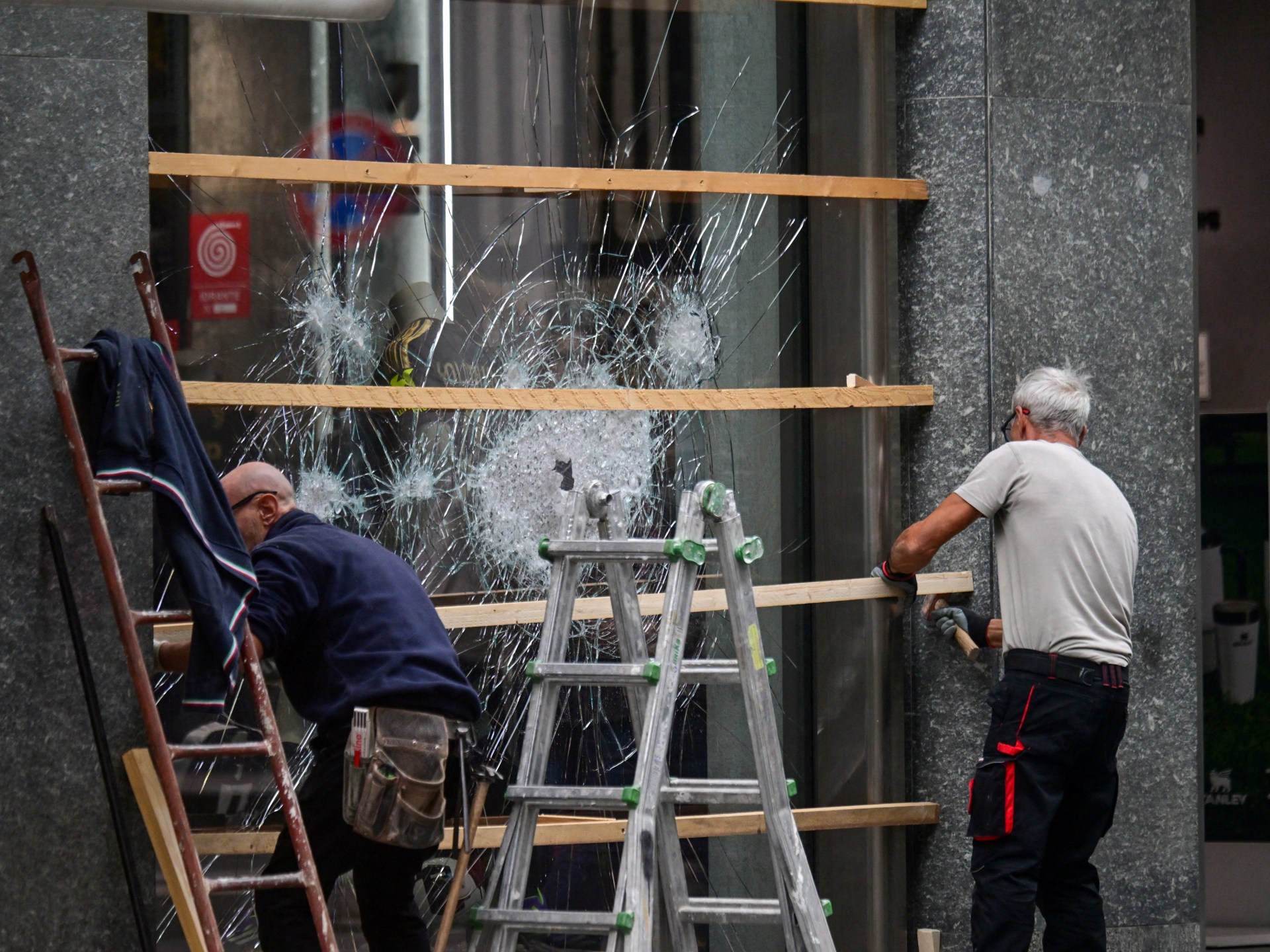
What had begun as a peaceful weekend protest in Milan turned into a riot, as groups made up mostly of young people looted shops, smashed windows and clashed with police. Masked demonstrators threw stones, paving blocks and other objects at riot police, and set fire to barricades built from bar tables. Riots were also reported in Bologna and Turin.
Official estimates of the cost of the damage in France and Italy have not yet been established.
Italy moves first
On Tuesday, the government of Italian Prime Minister Giorgia Meloni approved a package of measures in response to the unrest. It includes sending 500 soldiers to Milan until the end of the year and raising the financial liability of parents whose children took part in vandalism and looting.
Under the new rules, anyone who joins a group of at least five people and endangers public safety during a protest faces up to five years in prison and a maximum fine of 20,000 euros ($22,460). Protesters aged 14 to 18 can now be placed in administrative detention without having committed a crime, provided there is evidence that they pose a danger, extending powers that had applied only to adults.
Part of the decree, which carries the phrase “You break it, you buy it”, strengthens the law holding parents responsible for criminal damage caused by their children. Article 2048 of the civil code already makes parents and guardians liable for damages arising from the “unlawful act of unemancipated minor children or persons subject to guardianship who live with them. The same provision applies to the foster parent”.
Italian authorities can enforce such obligations through asset and wage attachments. The new measure allows the state to fine parents directly, claim damages against their property, or deduct the money from public subsidies the family receives.
The French route
Article 1242 of the French Civil Code imposes civil liability on parents who live with their children and exercise parental authority for damage the children cause. “Parents, in their capacity as holders of parental authority, are by right jointly and severally liable for damage caused by their minor children, except when the latter have been entrusted to a third party by an administrative or judicial decision,” the law states.
A law passed last year amended article 1242 to reinforce the role of parents during youth justice proceedings, removing the cohabitation requirement for civil liability to apply.
In France, compensation from parents can be pursued through civil proceedings and may include the seizure of assets where civil liability insurance, which is often attached to housing insurance, does not cover the damage, subject to the terms of the policy.
On Friday, the French radio station RFI reported that the government is also proposing a new bill known as “rioters pay” in response to the violent protests. The draft is scheduled for debate on October 27.
If it becomes law, those found responsible for vandalism could be ordered to pay up to 10,000 euros ($11,200) in compensation, and parents could be held responsible where minors cause criminal damage. A provision could also introduce collective civil liability, potentially requiring a member of a group responsible for damage to pay even where they did not cause it themselves, on the same financial terms as those who did, according to RFI.
Prime Minister Sebastien Lecornu called the legislation “absolutely essential” to ensure that taxpayers do not pay for damage caused during protests.
Other countries also hold parents to account
France and Italy are not alone in placing financial responsibility on parents. In Sweden, parents or legal guardians may be held financially liable, within statutory conditions and limits, for certain injuries or property damage caused by a child who commits a crime.
In the United States, laws on parental responsibility vary by state and are subject to local conditions and limits. Where a minor intentionally destroys public property, businesses or vehicles, victims or local government can sue the parents in civil court.
Italy’s package has been approved, and France’s draft bill is due to be debated on October 27. Until then, the question of who pays for the broken windows, looted shops and burnt barricades remains open in Paris, even as Rome has moved to settle it.